Showing posts with label Culturally Responsive Teaching. Show all posts

Tuesday, July 11, 2023

Diving Deeper with the SAMR Model

    In the ever-evolving landscape of education, teachers are constantly seeking innovative ways to engage their students and deepen their understanding. Enter the SAMR model—a framework that encourages educators to transform their teaching practices to higher levels of engagement and learning using technology integration. Here is a run-down on the basics of the SAMR model:
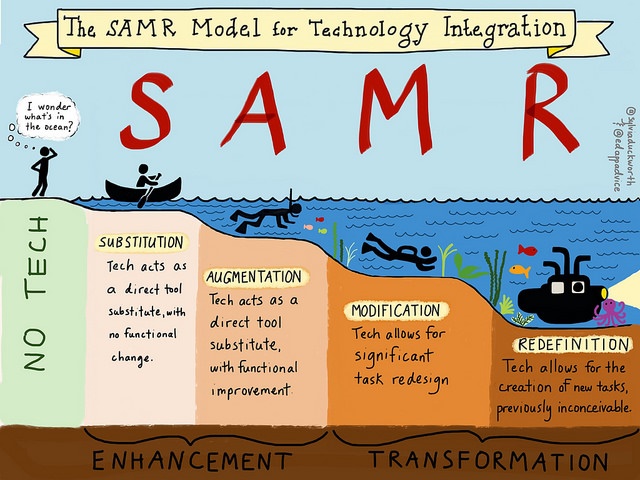

    By moving beyond simple Substitution and incorporating Augmentation, Modification, and occasionally reaching Redefinition, teachers can empower students to utilize their skills for research, share their knowledge with peers, make connections, and develop a well-rounded understanding of the world. Beyond the model shown above, here are some simplified key points and examples that may help in understanding each stage of technology implementation: 

  • Substitution = Doing old things in old ways
    • Examples: Replacing a manual GPS with a smartphone's GPS app; replacing a hardcopy of a dictionary with Google's "Define" function 
  • Augmentation = Doing old things in new ways
    • Examples: Replacing hardcopy books with eBooks where the user can highlight sections, define vocabulary, and share the source with others; replacing paper maps with Google Maps where the user can see ratings for their destinations, images, fastest routes, hours of business operation; replacing the chore of handwashing dishes to using a dishwasher
  • Modification = Doing old things in better ways
    • Examples: Replacing hardcopy books with audiobooks so that the user can listen while completing other tasks, or so that a user who struggles with reading can engage audibly; using Google Drive rather than handwriting/printing numerous drafts of an essay, reducing paper waste and allowing the user to simply make changes rather than rewriting the same work multiple times
  • Redefinition = Doing new things in new ways
    • Examples: Transportation by airplane rather than by car or train, gaining access to the rest of the globe rather than being landlocked; using Venmo for payments rather than cash, increasing convenience while also reducing the risk of pickpocketing
    By guiding students through the research process and providing technological resources, teachers can foster critical thinking and information literacy skills. The shift from substitution to augmentation allows students to take ownership of their learning and explore topics in new ways. To further elevate engagement and understanding, teachers can facilitate opportunities for students to share and teach their research to their peers. This not only enhances their presentation and communication skills but also promotes collaboration and new perspectives for understanding of the subject matter. Peer teaching encourages students to explain concepts in their own words, reinforcing their understanding and fostering a supportive learning community; therefore, fitting into the category of redefinition.

    Making connections is another crucial aspect of the SAMR model. Teachers can help students see the bigger picture by encouraging them to explore how their research and learning connect to other material or topics. By drawing parallels, students develop a holistic understanding of the subject matter and its relevance in various contexts. Engaging in conversations with individuals from different cultures and perspectives further broadens their horizons, challenging assumptions and nurturing empathy. 


    To achieve this, teachers can introduce redefinition by stretching the boundaries of traditional classroom experiences. Inviting guest speakers into the classroom, organizing virtual Zoom calls with experts from around the globe, and encouraging students to create their own unique renditions of projects are just a few ways to foster a deeper connection to the real world. These experiences inspire creativity, critical thinking, and problem-solving skills, transforming students into active contributors and shaping their understanding of the subject matter on a profound level.

    Incorporating the SAMR model into lesson planning allows teachers to embrace the transformative power of technology and pedagogy. By gradually moving from substitution to augmentation, modification, and occasionally reaching redefinition, teachers empower students to become active learners, critical thinkers, and global citizens. With this approach, education becomes a dynamic and enriching journey, propelling students towards higher levels of engagement, understanding, and success.


With support from Generative AI

Friday, July 23, 2021

Practice what you preach

    I believe educators today need to keep a growth mindset not only to set a good model for their students but also because we need to allow ourselves room to make mistakes and learn from them. It can be easy to forget that students are not the only ones learning at school, and this further supports the idea of social-emotional learning. We too are human and will eventually make mistakes or have something go less than adequate, and we need to grant ourselves the same kindness we will show our students when they make mistakes. I believe the times when teachers make mistakes are some of the most crucial moments in the classroom because it sets the expectation for students to follow. If a teacher makes a mistake and tries to hide it or react to it in a negative manner, that subconsciously tells the students that making mistakes is a negative thing that they must avoid doing to whatever extent they decide to take it. If the teacher takes the time to address the mistake and displays a collected and logical approach to fixing it, they are destigmatizing making mistakes and giving normalcy to seeing mistakes as opportunities for learning and improvement. 


    We may only have students for one calendar year, but the habits they pick up in school regarding their study habits, self-esteem, problem-solving, and bravery to take risks stays with them until they have to actively work at unlearning those habits. It is in their best interest as future functional members of society, and for us as educators serving hundreds of them to keep in mind just how mouldable their minds are as children, and we need to take caution of the hidden curriculums and unspoken rules that might be communicated. Transparency, a collective group effort to identify problems as they arise and solve them as a team, and open and respectful communication can go a long way for students, especially those that may not have healthy relationships in their personal lives.

What a time to be alive amirite?

    I am extremely excited for the future of education and even more so to be a part of it. Education is finally moving away from the framework that is designed to do little more than train children for the workforce and is moving toward equipping students with REAL life skills fit for our modern society. In my experience, school always just felt like a scam because I didn't feel like I was learning anything really useful to me (which, let's be honest, is more true than I would like it to be) but I had no choice but to go and the only motivation to even graduate was the social pressure rather than a desire to grow and learn. I believe this shift in goal orientation from content-driven to skill-driven is revolutionary and I am filled with anticipation to find out how this new framework is going to change society long-term. Many educators have ignored the resources that technology can provide us with for too long, and the trial this recent panini forced us into has been so much more successful than anybody expected and even a clear improvement from the old design in many ways. I believe we can and must continue this shift to the point where we no longer create curriculums based on the student's anticipated success on a standardized test but instead create curriculums based on the student's interests, assets, and needs.

    This system of memorizing a bunch of content to prepare for several high-stakes standardized tests that are essentially all the same, and is also severely exclusive to a distinct population of students with the ability to succeed in these conditions. However, the tests are still damaging to all students because they are not learning critical thinking skills, research skills, creativity, or individuality which has fueled a society of complacency, apathy, and redundancy. Students do not need to rehearse over and over how to fill in hundreds of little bubbles, and the skills they are supposed to be using to answer these questions become overshadowed by the content itself. There are now so many other and more effective ways to assess progress in students and technology is largely to thank for this. If the curriculum is student-centered, the assessments should be student-centered as well and technology has finally been recognized to allow educators the space, time, and resources to tend to the unique needs of each student on a one-to-one scale much more efficiently and personally. 

    Although I must say I am a bit jealous that I could not grow up in a school system with this new frame of mind and the resources made possible by modern technology, I cannot wait to be a part of it from the teacher's perspective of things.


Monday, July 12, 2021

The One True Learning Theory Doesn't Exist


About Culturally Responsive Teaching

Article here: https://www.cultofpedagogy.com/culturally-responsive-teaching-strategies/           

Trying to teach Black students by rapping or Latinx students by talking about Cinco de Mayo tokenizes students. I was never motivated to participate by being compelled to act as “the Jewish expert” when I was growing up.

The way to activate and engage students is through genuine, authentic connection. Without achieving authentic connection between students and teacher as well as peer to peer, learning will be stilted at best. Trust is the first step in learning.

We know that many children have Adverse Childhood Experiences (https://www.cdc.gov/violenceprevention/aces/index.html) during K-12 education, and that these experiences can scar them for life. What can we do to better support the children in our classrooms as they are going through one of the most formative periods of their lives?

I feel quite strongly that the first few weeks of school, and whenever a new student is added to the classroom, must be spent building authentic connections.

We have to acknowledge that all of our students are from diverse backgrounds. Each one of them is unique, a human being with a human being’s story. Family, or no family, friends, or no friends… we all come to the table with everything that we’re born with and that we have lived. What is most important is that everyone has a voice, and that their voice is heard and valued. Listening skills are key. Many paths to knowledge and different pieces of knowledge depending on capacity must be available and easy to access. Technology is one of the necessary paths that must be widely available and utilized regularly.

I have been feeling frustrated by the theories of behaviorism, cognitivism, and constructivism. This idea of one theory being correct above all others doesn't make sense to me and seems too simplistic. I believe that reality is internal, external, and interpreted; and I believe that knowledge is both innate and acquired through experiences, thinking about experiences, and constructed.  

These things all go together. How learning happens is both clearer and more nebulous than I have seen properly articulated by any learning theory I have yet read. It almost seems as if there’s a desire to find the “One True Path” when such a thing does not exist. Teachers must meet students where they are and provide them with genuine connection and a broad range of social and academic activities.