Showing posts with label Wikipedia. Show all posts

Wednesday, July 20, 2022

So you're telling me... I can cite Wikipedia as a reliable source?

In my K12 experience, Wikipedia had a bad rap. I remember the common refrain before every research project: "...and you CANNOT use Wikipedia as one of your sources!" 

Poor Wikipedia. Seemingly the bane of all secondary teachers.  

Perhaps there was a time in Wikipedia's earlier years when it could never be used as a trustworthy source. Today, however, with the rate at which information changes and the number of editors on Wikipedia pages, it might not be as dicey as everyone thought. 

I was particularly astonished to learn in Jeff's class that the half-life of facts today is just a number of months. Having an online encyclopedia that can be updated in real time allows for the possibility of a source that is up-to-date and fact-checked by swaths of people from all over the world. This is not to say that all Wikipedia articles are equivalent to a peer reviewed journal article, but some of them certainly are, and some may be even more reliable than more traditionally accepted sources, such as textbooks and other websites. For example, how often in school did we question a textbook's validity based on how long ago it was published? And the question Jeff posed that really stuck with me was, how often are we asked to research the textbook's editor? In my experience, both of those answers are "never."

In the age of technology, part of our jobs as educators is to teach students how to think critically and learn how to evaluate the legitimacy of all the information that is being thrown at them. Instead of completely swearing off Wikipedia, what if we invited our students to evaluate for themselves whether the page they are on is reliable or not? 

Conveniently built into Wikipedia's website is the ability to check each page's reliability. (I don't know how I never knew about this until last week!). Users can click on the "Talk" tab at the top of their article and immediately see a quality grade for the article as well as feedback regarding its accuracy. Anything above an A is exceptional and comparable to a professional encyclopedia. Here is a link to an explanation of Wikipedia's Quality Scale.


Wikipedia is also an incredible avenue for students to make meaning of their own research. When I was in my senior year of undergrad, I took an art history course entitled "Art and Activism in Latin America." We learned about seminal artists from Latin America in the 20th century that have historically been underrepresented in the global art world. As our final project, the professor let us each choose a Wikipedia page that had not been thoroughly developed and contribute to its contents. 

This was a wonderful opportunity for me to feel like my research was actually meaningful and to positively contribute to the representation of these artists and artistic movements. (Speaking of which, if you are interested in learning about the Nueva Figuración movement, you can check out the page I contributed to here :) )

I would love to do research projects in this way and give students the opportunity to see their work posted on Wikipedia. It helps students see the relevance and importance of the work they do in school and empowers them to see how they can make an impact outside of the classroom.

Thanks, Wikipedia, for surprising me in the best of ways.

Monday, July 19, 2021

Wikipedia is here to stay


I had only recently in the last few years started to hear some buzz about Wikipedia's surprising level of reliability when I started to assimilate into the education community through music education conferences and workshops. I had no idea about the rating system or the coordination that goes into maintaining pages on the site though, and I was quite shocked at first! Now I almost feel compelled to go out and start looking for pages to supplement, although I probably won't go that far until I have more free time on my hands. This in itself goes to show that education and learning are collaborative because complete strangers around the world are coming together to provide anyone with an internet connection easy access to knowledge for free. I think it’s important to keep the love of learning alive in students and providing such easy access to knowledge will help fuel this love, but it is important that we teach students to evaluate the credibility of their sources and teach them how to research properly. 

I think it’s extremely valuable to have such a massive database of knowledge on pretty much anything you can think of in a digital and changeable format. Information changes constantly as new things are being discovered, and as those discoveries happen the documentation can change with it in real-time, and we will never lose that access as long as technology still survives. There has been so much documentation, culture, and knowledge lost to age or deliberate destruction over time, more than we could even fathom. I often think about the Library of Alexandria and wonder what information we could have still had access to if it hadn’t been devastated. I find it comforting that there is so much information stored on the internet that will never be destroyed.


The Library of Alexandria

Wednesday, July 14, 2021

#Google #Community #Hashtag

The final words of Jeff have been ringing in my ears. After being on technology overload for the past two days, the one thing that I cannot stop thinking about has nothing to do with technology. It has everything to do with being a human being.

The best thing we can do as educators is love our students from the moment they walk into our classrooms and never stop.


No matter how much we practice with technology or study all of the benefits that it brings to the classroom, we cannot change the fact that we are human beings and that we have needs that transcend technology. 

We all have a need to be seen.

To be loved.

To belong.

The beautiful part about technology is that it can be utilized in the classroom to create and foster a sense of belonging and community.

Take Google maps for example. Google mymaps can be used to show how our students are connected with each other and how our students are connected around the world. We can utilize Google mymaps to map out the location of everyone's houses. Doing this gives a visual representation to how close or how far everyone is living from each other. It can also provide a spark or connection for that new student who is looking for a way to connect with their classmates. Google mymaps can be utilized to plot points of the places everyone visited over the summer or maybe spark an interest in students of where they might want to visit one day. When students can visually see these connection points, it provides them with the opportunity to build community based on place and interest.

Take Wikipedia for example. A Wikipedia article is basically a community of individuals looking to provide the world with accurate and unbiased information on a topic that they find interesting. Think about all of the great projects that can come from this concept.  Students can be linked together through common interests and then sent off to provide the rest of the world with the best Wikipedia article they can produce through collaboration. As students are working together, they might "meet" other people from around the world that become part of their "Wikommunity." 

Take the hashtag for example. Creating a classroom hashtag lets educators engage their students on social media in a way that was never possible before. Creating a classroom hashtag allows educators to create communities that can travel together. Creating a classroom hashtag builds a community with an online portfolio for all time. The possibilities are endless!

For all of technology's short falls, it can still be utilized to meet that basic human need of...

#community

#belonging

#love


Monday, July 12, 2021

Wikipedia Gems

    It's fun to figure out as an adult that Wikipedia is useful tool... after having it hammered home that students should never use it, and it is not reliable. I wish I would have known the value and usefulness of Wikipedia when I was in school.
    One of the biggest takeaways from learning about Wikipedia for me was the quality scale. I think that this is a great tool to know moving forward. One can easily check to see what the quality of information is. Knowing what I know now makes Wikipedia a great place to go when looking for potential sources. I had no idea that there are so many scholarly sources cited within a Wikipedia page. Again, this would have been helpful information to know as Wikipedia could have been a very helpful and useful tool for research.

Sunday, July 28, 2019

Wikipedia... The New and RELIABLE Encyclopedia?

It seems as though for anything you search through Google one of the first websites listed is a Wikipedia article on the topic. We've all heard the stories of how Wikipedia is an unreliable source that we must never use because of its false facts it tries to state. But are all of these stories of its unreliability true? If you simply type "is wikipedia reliable" into your search bar of Google and hit enter, the first result would be a Wikipedia article no less that directly states "Wikipedia is not a reliable source" in bold font.


https://en.wikipedia.org/wiki/Wikipedia:Wikipedia_is_not_a_reliable_source


The article goes on to say that anyone can edit the documents that Wikipedia produces, so it must not be a reliable source right? Wrong... well, kind of. The article is correct in saying that the documents on the site are editable by anyone, but does that then make it unreliable? One thing that most people don't often know is that Wikipedia has a scale of reliability of their pages. Yes, an actual scale to grade their articles, and the scale can be viewed for any of the pages they run. To view this scale, the viewer simply needs to click on the tab labeled "Talk" on the top bar of the page. The talk page of a Wikipedia article is used for discussing and viewing improvements and general information about the article. This section of the webpage is where the scale of reliability can be found on the webpage. For example, the "Talk" section for the Wikipedia page of the term "Dog" looks like this:


https://en.wikipedia.org/wiki/Talk:Dog


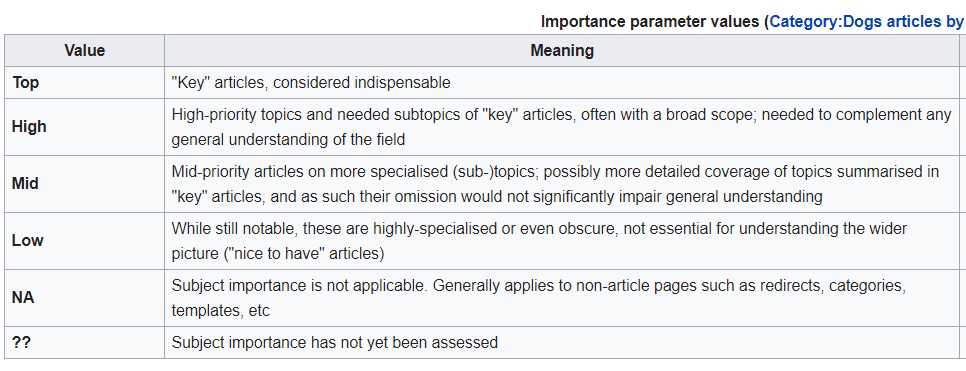
The bottom of this yellow box is where the scale of reliability can be viewed. For this particular page, Wikipedia has listed this "Dogs" page within three different WikiProjects and shows their scale within each project. Lets take a closer look at these scales. The first project for instance deals with Dogs/Breeds. Within this particular project, the article is rated as a "B-Class, Top-Importance" document. But what does that really mean. Going to the following page will show the scale Wikipedia uses to rate these articles as shown in the picture below.


https://en.wikipedia.org/wiki/Wikipedia:WikiProject_Dogs/Assessment#Quality_scale


Wikipedia uses a two step process for their scale of reliability. The first is to classify the article within one of their nine categories that are: FA, A, GA, B, C, Start, Stub, FL, and List. Each category has a description of why an article may be listed within that. For instance, a "Start" article is "an article that is developing, but which is quite incomplete. It might or might not cite adequate reliable sources." This scale of classification is a sort of A-F grading scale commonly used within a classroom. Generally the higher the article is rated, the more reliable the article is.


https://en.wikipedia.org/wiki/Wikipedia:WikiProject_Dogs/Assessment


The second step Wikipedia uses to scale the articles reliability is a scale of importance within the initial category and the project as a whole. This scale shows whether an article has Top, High, Mid, or Low importance overall.

So going back to the example of the "Dogs" article that has a classification of "B-Class, Top-Importance" within the WikiProject Dogs/Breeds. This classification means that the article is mostly complete and without major problems and is of the highest importance classification within the category Dogs/Breeds. Therefore, the article about "Dogs" seems to be pretty reliable according to Wikipedia. Lets take a look at an article that isn't rated so highly. For instance, the article labeled "The Last Airbender Trading Card Game" as shown in the image below.


https://en.wikipedia.org/wiki/Talk:Avatar:_The_Last_Airbender_Trading_Card_Game


Within the "Talk" page for this article the document is listed within three WikiProjects, and in each it is rated as a "Start-Class, Low-Importance" article, therefore it seems as though it is less reliable in the grand scheme of things. This rating given by Wikipedia shows this article as being a fairly new (Start) article with little significance to the WikiProject... but how does Wikipedia decide that rating? Essentially the rating is determined by the group of people who run the WikiProject. These WikiProjects are run by groups of Editors with certifications that allow them to run the projects. These teams of editors are the people who determine the rating for the various articles. Anyone who is a member of an article page can request for their page to be reviewed by these teams of editors. If they disagree with the rating given to the page, they can request a review of the rating and ultimately get their articles reassessed (after a specified time from the initial assessment). These ratings are certainly subjective, as they are given to the articles by people (and everyone has some kind of bias despite efforts to remove the bias). However, by introducing a team of editors to review the articles, Wikipedia has reduced the amount of initial bias introduced to rate the articles.

It is true that Wikipedia does allow for anyone to edit and change the articles as they please, making it seem unreliable to most. However, Wikipedia has a group of editors to rate the article, so anyone that views the article can see how reliable that document is. This editability feature of the website led to mass panic by teachers of the early 2000's to try and get their students to not use the website for fear of it being an unreliable resource. However, Wikipedia offers a trackable categorization to the reliability of the document that is run by a team of editors. If we teach or kids and students to dig deeper and figure out for themselves whether the page is reliable and to view the scales given, Wikipedia can be one of the most useful resources we use to research various topics.

Wikipedia is a RELIABLE encyclopedia... IF we know how to use it.

Mr. Brandon Berk
Mt Spokane High School
Spokane Washington

Monday, July 16, 2018

You shall not pass (if use use credible websites way more accurate than our textbooks)

"If you use Wikipedia in your essay, I'll know."


An iconic lie by three high school teachers and four college professors. This line was about as believable to us students as, 

"It'll be obvious if you don't read the book, SparkNotes isn't a good idea."

Let's be real, most people have never actually made it past the third chapter of Lord of the Flies and have flocked to sources like Quizlet and SparkNotes. 


Anyone that was born before or in this generational gap we are in would probably say utilizing those sites mentioned above is cheating. How?

We are engaging our students in the Internet of Things, they are learning valuable research skills, and at the end of the day, if they the assignment is constructed in a way that encourages critical thinking rather than simple fact-based answers, the origin of the knowledge of  the book is insignificant. 

The bottom line is that these resources are here and they aren't going anywhere. in fact, there will always be even a better and more efficient option taking their places in a blink of an eye. Instead of shunning them and kids taking extreme measures to cover up their inevitable usage. Utilize those incredible sites and take advantage of the wealth of knowledge (and even the occasional radically off base ideas) and have the kids make an impact and engage them in much bigger ideas. 

Image result for wikipedia meme

I love the idea of teaching kids credibility online by using the "World's Rubric" in Wikipedia. I think using that and having students edit those low graded pages is an incredible way to validate student work.