Monday, July 24, 2023

Multi-Sided Research

Multiple Perspectives in Research

Introduction

In an era where information is at our fingertips, search engines have become the go-to tool for accessing knowledge. Google, the search giant, has not only revolutionized the way we seek information but has also emphasized the importance of allowing multiple perspectives in research. As a company committed to promoting diversity of thought, Google recognizes the significance of incorporating different viewpoints in its products, services, and research.

Overcoming Bias and Blind Spots

Google encompasses a wide range of perspectives, experiences, and ideas .Google, as the world's leading search engine, plays a pivotal role in connecting users to a vast array of information. One key feature that sets Google apart is its ability to allow users to research through different country codes, also known as "Google country-specific domains." This functionality allows individuals to access search results specific to a particular country, which holds several vital benefits. Each researcher's unique experiences can uncover insights and nuances that might otherwise be overlooked, enhancing the overall quality of the research. A researcher is able to type site: (country code) or site: .gov / .org to find specific sources. This expands the ability to collect knowledge because someone is able to access another side to the story.

One example of this is that the United States calls the Vietnam War as such, but Vietnam wouldn't call it the Vietnam war because they were not at war with themselves. This gives a dynamic perspective because it shows less of an ethnocentric point of view. We're able to get access to first and secondhand account through going through another country's sources by using site: and entering the country code when we search on Google.

Research conducted solely from a single perspective can be susceptible to bias and blind spots. Incorporating multiple perspectives can also lead to a deeper understanding when doing research. The researcher is able to form their own opinion after seeing multiple perspectives.

By using the Google country-specified domains, we gain access to:

  • Localized Information: Different countries possess unique cultures, languages, and perspectives. By enabling users to search through country-specific domains, Google ensures they can access localized information. This localized content is particularly valuable for travelers, businesses exploring international markets, and individuals interested in understanding global perspectives.
  • Targeted Research: Researchers and marketers often need region-specific data and insights. By using country codes, professionals can narrow down their search results, gaining access to targeted information relevant to their specific audience or market.
  • Language Learning and Cultural Understanding: Researching through different country codes aids language learners in accessing authentic resources from their target language's native speakers. It also promotes cultural understanding, as users can explore content created by people from diverse backgrounds.
  • Stay Updated on Global Trends: In a rapidly changing world, being aware of global trends and events is crucial. Country-specific research allows users to stay updated on news and developments from various regions, fostering a more comprehensive understanding of the world.

  1. Conclusion

  1. In conclusion, Google's allowance for researching through different country codes enriches the search experience by providing localized information and enabling targeted research. This feature facilitates informed researches and opinions. By embracing and appreciating the value of different country codes, Google continues to enhance its status as a truly global search engine, connecting users with the richness of information from all corners of the world.


(Written with support from generative AI)

Plagiarism and ChatGPT

 ChatGPT and Plagiarism: A Struggle for Authenticity

Introduction

    In the age of advanced artificial intelligence, ChatGPT has emerged as a revolutionary language model capable of generating human-like text. Developed by OpenAI, ChatGPT is built on the GPT-3.5 architecture and has been integrated into numerous applications, from customer support to content creation. However, with its immense capabilities comes a pressing concern: plagiarism. This blog post delves into the connection between ChatGPT and plagiarism, exploring the challenges of maintaining authenticity in an era of AI-generated content.

The Promise of ChatGPT

ChatGPT was designed to help users access natural language processing capabilities without the need for extensive programming knowledge. By providing a user-friendly interface, the AI model opened up exciting possibilities for businesses, writers, and students alike. Tasks that once required hours of research and writing could now be accomplished efficiently and with ease, with ChatGPT serving as an indispensable writing assistant.

The Plagiarism Predicament

 Despite its promising potential, the surge in ChatGPT's popularity has led to an increased concern over plagiarism. As the tool can generate text that resembles human writing, the line between original content and AI-generated material blurs. This has made it easier for some individuals to resort to unethical practices, using ChatGPT to plagiarize others' work and passing it off as their own.

Educational Institutions' Dilemma

The widespread availability of ChatGPT poses a significant challenge to educational institutions. Teachers and professors face an uphill battle in detecting plagiarism in students' assignments. With AI-generated content now readily accessible, traditional plagiarism detection tools might fail to recognize such instances. As a result, maintaining academic integrity becomes increasingly difficult. This is more and more of a problem when students find out they can put in a certain amount of errors in their finished product, or they can change a few lines and get right past the automated detections.

Combatting Plagiarism with Technology

While AI has contributed to the plagiarism predicament, it can also serve as a potent tool to combat it. Developers and researchers are actively working on creating advanced plagiarism detection systems that can distinguish between original human-authored content and AI-generated text. By leveraging AI's capabilities for the greater good, these tools aim to protect intellectual property and promote ethical writing practices. Clear guidelines and ethical standards must be established and communicated to encourage responsible use of AI language models.
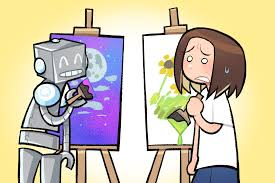
It isn't too difficult to tell when something has been created by AI versus being created by a human. For art, a lot of the times, hands and eyes are buggy and incomplete. Text and writing usually follows a format and there isn't necessarily a voice. I'm sure there are other methods to detect use of AI generated products, but for now, a lot of what we can do is just use our best judgement.

Cultivating Responsible AI Use

While it is true that ChatGPT can be exploited for plagiarism, the responsibility ultimately lies with the users. Technology is a tool, and it should be used as so. There are a lot of people going around and using ChatGPT to make money off of something that they didn't even create, and there in and of itself lies a huge moral battle. Is it okay for someone to profit off of someone else's hard work? This is especially present in art. Generative AI can be used for inspiration, and it can also be used to complete tedious and mundane tasks such as writing a cover letter or a college application essay on repeat for everything one applies for, but it should not be used for much more than that. It is incomplete by itself.

Conclusion

The rise of ChatGPT has undoubtedly transformed the way we interact with language and AI technology. However, with this transformation comes the challenge of maintaining authenticity and combating plagiarism. As we continue to harness the power of AI, it is essential to address the ethical implications of its use. By fostering awareness, promoting critical thinking, and cultivating responsible AI use, we can strike a balance between the benefits of AI-generated content and the preservation of intellectual integrity. Together, we can build a future where technology and human creativity coexist harmoniously.

(Written with support from generative AI)
UDL & Tech

UDL & Tech

Who knew how easy it would be to make our lessons more accessible? With the increase in technology over the last 10 to 20 years, a lot more opportunities have been created for students to have access to an inclusive classroom where they were not able to join before. What are some of the increases?

Google Docs, Word, and SpellCheck

    Well, there are a lot of different types of technologies that have helped provide inclusivity in the classroom. One of them is spellcheck. In Washington, there is a one screen to every one student policy, so every student now has access to a laptop or chromebook of some sort and is able to use Word or Google Docs to use spellcheck when writing an assignment. Also, for someone to be able to type instead of having to handwrite assignments allows for a lot more accessibility in the classroom. Someone who might not be writing at all is now able to type and their capacity for learning in school has grown significantly. 

ChatGPT

    There is also the newer technology of AI. ChatGPT has opened up a lot of opportunity. One example of this is a teacher could not get a student to want to read and couldn’t afford the books that the student was interested in. The teacher would have ChatGPT write a story or reading about space so that the student would have something to read. This gave the student access to reading in the classroom that they might not have accessed previously, especially with a limited supply of material that they are interested in. 

Noise Cancelling Headphones

            Another method of technology that has increased our ability to be more accessible is noise cancelling headphones. A lot of students have a difficult time focusing or learning with noises, and the introduction of noise cancelling headphones in the classroom as well as at school dances and other events, promotes inclusivity in the classroom and at school. Students are now able to be in classes and attend other events that they might now have been comfortable before. This helps with social emotional learning as well. Having kids in the classroom or attending school functions is almost always a positive relationship with learning.


FlipGrid 

            In addition to AI, Word, and noise cancelling headphones, there are also a lot of different ways for students to do assignments through the use of technology. FlipGrid allows students to record themselves instead of handwriting or typing. If you have a student who can create a story, but isn’t able to write it out, FlipGrip can be a wonderful option for them to record what is going on in their mind. There are a lot of different ways to complete a task, and allowing students different methods to reach the same outcome allows for an inclusive classroom and an exponential increase in learning. 


Conclusion

With the increase in technology, our schools are more accessible than ever before. There are a lot more technological advances that have happened, and this blog post highlights only a few of them. Hopefully there will also be many more.